





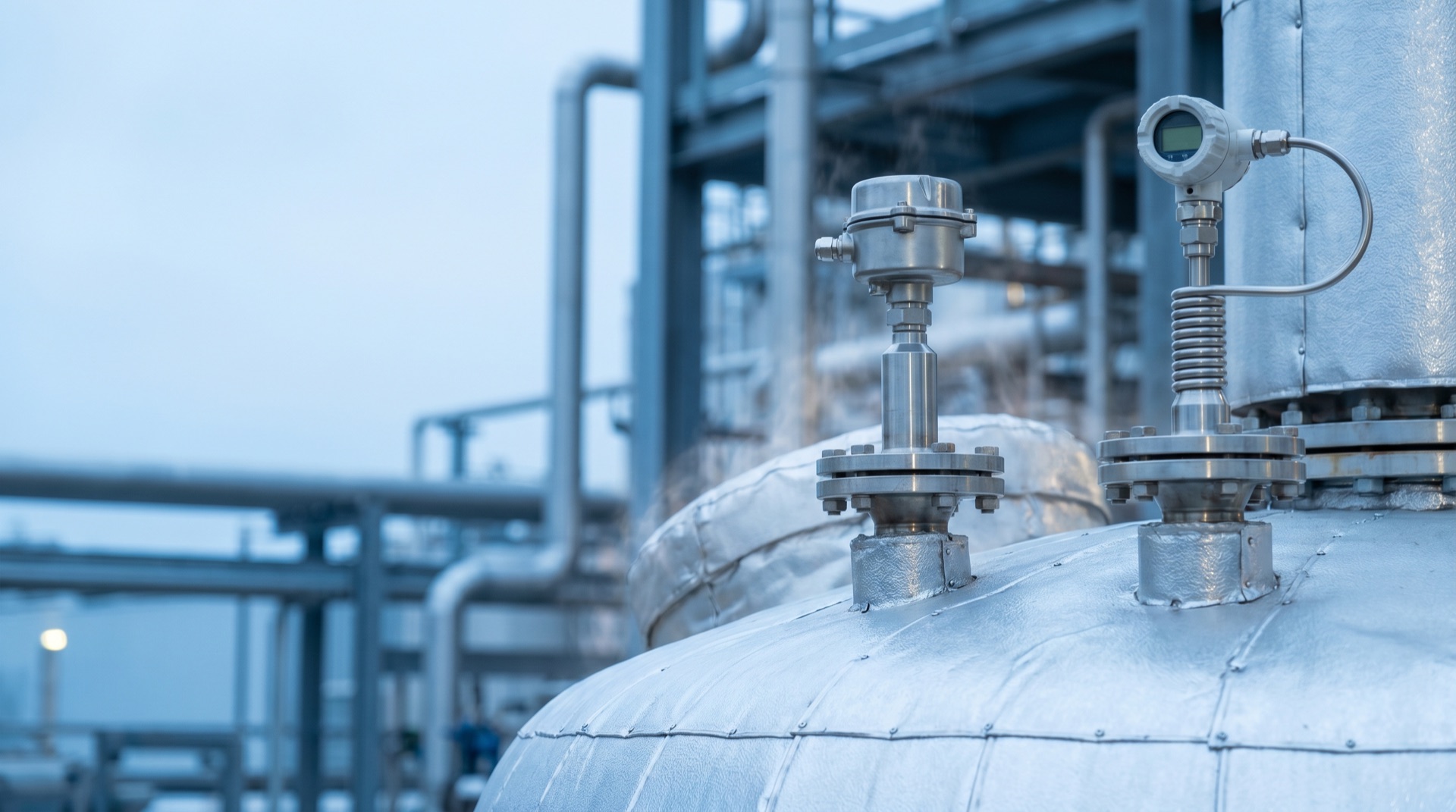
Few instrumentation decisions carry more consequence in a petrochemical or chemical plant than selecting continuous level technology for vessels operating at extreme temperature and pressure. Two contact technologies dominate the shortlist for these severe services: RF admittance level measurement and the guided wave radar level transmitter. Both mount through a single vessel connection, both deliver a continuous signal to the control system, and both can be engineered for punishing process conditions. Yet they behave very differently once coatings, low-dielectric media or rapid thermal cycling enter the picture, and choosing the wrong one is an expensive mistake.
This comparison is part of the CTH Industrial Controls definitive guide to industrial level measurement technologies, which examines every major measuring principle. Here we focus on how the two leading contact technologies stack up under extreme conditions in Canadian processing plants, and how to match each one to the right application.
What Is RF Admittance Level Measurement?
RF admittance level measurement is a refinement of capacitance technology. A rugged probe inserted into the vessel carries a low-power radio frequency signal, and the electronics measure the total admittance, the combination of capacitive and resistive components, between the probe and the vessel wall. As the process material rises and falls along the probe, the measured admittance changes proportionally, producing a continuous level signal with no moving parts.
The defining advance, a hallmark of Ametek Drexelbrook instruments, is a driven shield element positioned between the active probe section and the vessel connection. By holding the shield at the same potential as the probe, the electronics electrically ignore conductive build-up that would otherwise bridge the probe to the tank wall. This is what gives modern RF admittance instruments their well-earned reputation for coating immunity in sticky, viscous and crystallizing services. You can review the RF admittance level measurement product line that CTH supplies to plants across Quebec and the rest of Canada.
How a Guided Wave Radar Level Transmitter Works
A guided wave radar level transmitter operates on time-domain reflectometry. The instrument launches low-energy microwave pulses down a rigid rod or flexible cable probe; when a pulse reaches the surface of the process medium, a portion of its energy reflects back up the probe. The transmitter calculates level from the time of flight, a measurement that is inherently independent of density, viscosity, conductivity and most vapour-space conditions.
Because the pulse travels along a waveguide rather than through open space, guided wave radar (GWR) concentrates its energy and performs well in tall narrow nozzles, stilling wells and vessels crowded with internals. Many models also detect the interface between two immiscible liquids, such as oil over water, which makes them popular in separators. Explore the guided wave radar level measurement products available through CTH for continuous service.
RF Admittance vs. Guided Wave Radar: Side-by-Side Comparison
The table below summarizes how the two technologies compare on the criteria that matter most in extreme-condition applications.
| Criterion | RF Admittance | Guided Wave Radar |
|---|---|---|
| Measuring principle | Admittance change between probe and vessel wall | Time of flight of guided microwave pulses |
| Coating and build-up | Excellent immunity with driven-shield designs | Heavy or conductive coating can attenuate or distort the signal |
| Dielectric sensitivity | Handles conductive and insulating media; configuration reflects the product | Needs sufficient dielectric contrast; very low-dielectric media weaken the echo |
| Foam and vapour | Tolerant of dense vapour; conductive foam may read as level | Reads through most foam and vapour; heavy flashing needs configuration care |
| Interface measurement | Limited | Strong capability for clean two-liquid interfaces |
| Moving parts | None | None |
| Typical strengths | Sticky, coating, corrosive and very hot media | Low-maintenance continuous level, interface duty, crowded vessels |
Coating Immunity: The Decisive Factor in Sticky Services
Build-up is the silent killer of contact level instruments. Polymers, asphaltenes, caustic salts and crystallizing brines all leave residue on probes, and an instrument that cannot distinguish coating from true level will drift until operators stop trusting it. RF admittance instruments with a driven shield were engineered specifically for this problem, and they remain the benchmark wherever conductive coatings are unavoidable.
Guided wave radar tolerates light films well, but a thick or conductive coating along the probe can attenuate the pulse, create false echoes or shift the apparent level. In services where the vessel is cleaned regularly, or where build-up is thin and non-conductive, GWR performs reliably; in chronically fouling services, RF admittance usually wins.

Dielectric Constant: Where Guided Wave Radar Meets Its Limits
The strength of a radar reflection depends on the dielectric contrast between the vapour space and the liquid surface. Liquefied gases, light solvents and some petrochemical intermediates have very low dielectric constants, which weakens the returned echo. Modern GWR transmitters mitigate this with coaxial probes and end-of-probe tracking algorithms, but every application should be checked against the manufacturer’s dielectric guidance before a model is committed to the project.
RF admittance has its own dielectric considerations: insulating media produce smaller admittance changes than conductive media, so probe selection and calibration must reflect the product. The practical difference is that RF admittance does not rely on a reflected echo, so it is unaffected by foam scatter, surface turbulence or weak reflections in the way a radar device can be.
Level Measurement at Extreme Temperature and Pressure
Extreme temperature level measurement is where both technologies separate themselves from ultrasonic and other general-purpose options. RF admittance probes can be built with high-temperature insulators and remote-mounted electronics that keep sensitive components away from the heat, which has made them a long-standing choice for hot, pressurized reactors and distillation columns. Guided wave radar versions with specialized high-temperature seal systems likewise serve hot, high-pressure vessels, including saturated steam applications when vapour compensation is properly configured. In every case, confirm the temperature and pressure ratings against the manufacturer’s documentation for the exact model and process connection before specifying.
When conditions exceed what any intrusive probe can survive, or when the medium is too aggressive to touch at all, plants step up to nuclear level measurement systems for extreme process vessels, which measure straight through the vessel wall.
Installation and Commissioning Considerations
Both technologies install through a single threaded or flanged connection, but a few practical details decide long-term success:
- Probe selection: rigid rods suit shorter vessels, flexible cables with bottom anchors suit tall tanks, and coaxial designs suit clean, low-dielectric liquids.
- Nozzle geometry: long or narrow nozzles affect the GWR launch zone, while RF admittance designs use shield length to neutralize build-up inside the nozzle.
- Clearance from internals: agitators, ladders and heating coils near a GWR probe create stray reflections; route the probe with adequate clearance or use a stilling well.
- Configuration: GWR is typically set up from vessel geometry without wetting the probe, while RF admittance benefits from configuration that accounts for the product’s electrical properties.
- Maintenance access: remote-mount electronics simplify servicing on hot, vibrating or hard-to-reach vessels.
Choosing the Right Technology for Petrochemical and Chemical Plants
As a working rule, favour RF admittance where coating, corrosion and very high temperatures dominate, and favour a guided wave radar level transmitter where interface measurement, low maintenance and configuration simplicity matter most in relatively clean media. Many plants standardize on both, applying each where it is strongest, and pair their continuous transmitters with independent point level switches for high and low alarms. For clean liquids in vessels where nothing should touch the product, see our comparison of non-contact radar and ultrasonic level sensors.
CTH Industrial Controls supports petrochemical facilities and chemical processors across Quebec and Canada with the complete continuous level measurement line from Ametek Drexelbrook, along with application support for the many other industries we serve.
Frequently Asked Questions
Is RF admittance the same as capacitance level measurement?
They share the same physical basis, but RF admittance adds a driven shield and measures the resistive as well as the capacitive component of the signal. Those refinements let it ignore the conductive coatings that cause classic capacitance probes to drift, which is why RF admittance level measurement is preferred for fouling services.
What dielectric constant does a guided wave radar level transmitter need?
It depends on the probe style and the model. Coaxial probes handle the lowest-dielectric liquids, while single-rod probes need more reflective media. Rather than relying on a generic threshold, have the actual process fluid evaluated against the transmitter manufacturer’s application guidelines, something CTH’s application engineers do as part of every technology selection.
Which technology is better for level measurement at extreme temperatures?
Both can be engineered for severe service. RF admittance with remote electronics has a long track record on hot, coating-prone vessels, while high-temperature GWR variants with specialized seals serve hot, high-pressure applications including steam. The deciding factors are usually coating behaviour and dielectric properties rather than temperature alone, and ratings should always be verified for the specific model.
Can guided wave radar measure an oil and water interface?
Yes. Interface measurement is one of GWR’s signature capabilities, provided the upper liquid has a lower dielectric constant than the lower liquid and any emulsion layer between them is limited. RF admittance is generally not applied to interface duty, so separators and desalters tend to favour guided wave radar.
Does foam affect RF admittance or guided wave radar more?
It depends on the foam. Conductive foam may read as level on an RF admittance probe, which some overfill-protection applications actually want. Guided wave radar typically sees through light foam to the liquid surface, but dense conductive foam can attenuate the pulse. Characterizing the foam is a standard part of a proper application review.
Request an Application Engineering Consultation
Every extreme-condition application deserves a thorough review before a technology is chosen. CTH Industrial Controls’ application engineers will evaluate your process conditions, recommend RF admittance or guided wave radar where each fits best, and draw on the full range of manufacturers CTH carries to specify the right instrument. Request an application engineering consultation today, and continue exploring our complete guide to industrial level measurement technologies to compare every option side by side.