





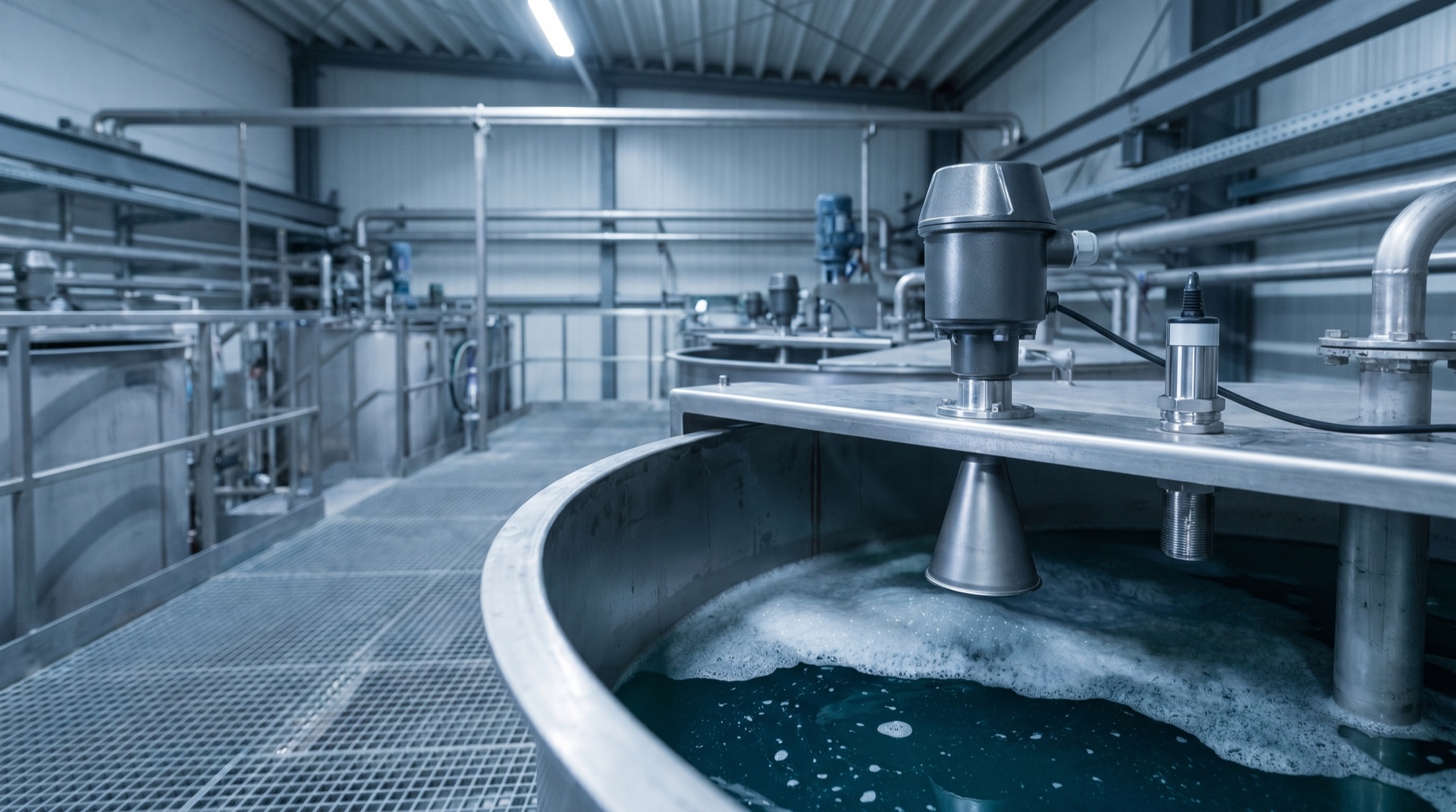
Open clarifiers, chemical storage tanks, wet wells and reagent vessels share a common requirement: an accurate level reading without putting the instrument in contact with the process fluid. Non-contact level measurement meets that requirement with two proven technologies, the radar level transmitter and the ultrasonic level sensor. Both measure from above the liquid, both eliminate corrosion and coating concerns at the sensing element, and both have distinct strengths that make them the right choice for some vessels and the wrong choice for others. This article compares the two for the water, wastewater and chemical applications we encounter most often across Quebec and Canada, and forms part of our definitive guide to industrial level measurement technologies.
Both instruments work on the time-of-flight principle: emit a pulse toward the liquid surface, time the returning echo and convert that interval into a distance and a level. The difference is the kind of pulse doing the travelling, and that single difference drives nearly every selection decision that follows.
How Non-Contact Level Measurement Works
Radar Level Transmitters: Microwave Time-of-Flight
A radar level transmitter emits microwave energy from an antenna mounted at the top of the vessel. The signal reflects off the liquid surface, with echo strength determined by the dielectric contrast between the vapour space and the product, and the electronics convert the return time into a level value. Because microwaves travel at the speed of light, the reading is essentially unaffected by temperature swings, vapour composition, pressure, vacuum or air movement. That independence from the atmosphere above the liquid is the defining advantage of free-space radar. CTH supplies open air radar level measurement instruments for these duties, alongside the broader Foxboro radar level measurement portfolio for process vessels and storage tanks.
Ultrasonic Level Sensors: Acoustic Time-of-Flight
An ultrasonic level sensor uses a piezoelectric transducer to launch an acoustic pulse through the air or gas above the liquid, then listens for the echo with the same transducer. Sound is a mechanical wave: it needs a gas to travel through, and its velocity changes with temperature and gas composition. Quality instruments compensate for air temperature at the transducer, which is why ultrasonic technology performs so dependably in water and wastewater service, where the vapour space is typically humid air at moderate temperature. Our ultrasonic level measurement range is anchored by Pulsar, whose self-contained and remote-transducer instruments are widely specified for municipal and industrial duty.
Radar vs. Ultrasonic: Comparison at a Glance
| Factor | Free-Space Radar | Ultrasonic |
|---|---|---|
| Measurement principle | Microwave time-of-flight | Acoustic time-of-flight |
| Vapour and gas composition | Minimal effect on accuracy | Alters the speed of sound and can shift the reading |
| Temperature in the vapour space | Largely immune | Requires compensation; thermal gradients add error |
| Vacuum or elevated pressure | Suitable within the device rating | Unsuitable for vacuum; limited pressure capability |
| Foam | Light foam often tolerated; heavy foam attenuates the echo | Foam absorbs acoustic energy and can mute the echo entirely |
| Product properties | Needs adequate dielectric contrast for a strong echo | No dielectric requirement; reflects off virtually any surface |
| Beam behaviour | Narrower, more focused beam, especially at higher frequencies | Wider beam that needs a clear, unobstructed path |
| Typical strengths | Corrosive or vapour-laden vessels, tall narrow tanks, outdoor service | Wet wells, reservoirs, open tanks and channels at ambient conditions |
| Relative installed cost | Generally higher | Generally lower |
Beam Angle and Mounting: Getting a Clean Echo
Every non-contact instrument projects its energy in a cone, and anything inside that cone can return a false echo: ladder rungs, pipes, agitator blades, wall encrustation or the fill stream itself. Beam angle therefore matters as much as raw accuracy. Higher-frequency radar transmitters produce a narrow, focused beam that can thread past internal obstructions and remain usable in tall, narrow vessels or long nozzles where a wider beam would see the tank wall before it ever saw the liquid.
Ultrasonic sensors typically project a wider cone and also have a blocking distance, a near zone immediately below the transducer where echoes cannot be resolved. The sensor must be mounted so the maximum liquid level stays below this dead band, with the transducer face perpendicular to the surface and well clear of turbulence, filling streams and standing internals. On an open clarifier or a flat-roofed reservoir those conditions are easy to satisfy; inside a cluttered chemical reactor they often are not, which is one more reason radar tends to win in process vessels.
Vapour, Foam and Corrosive Service
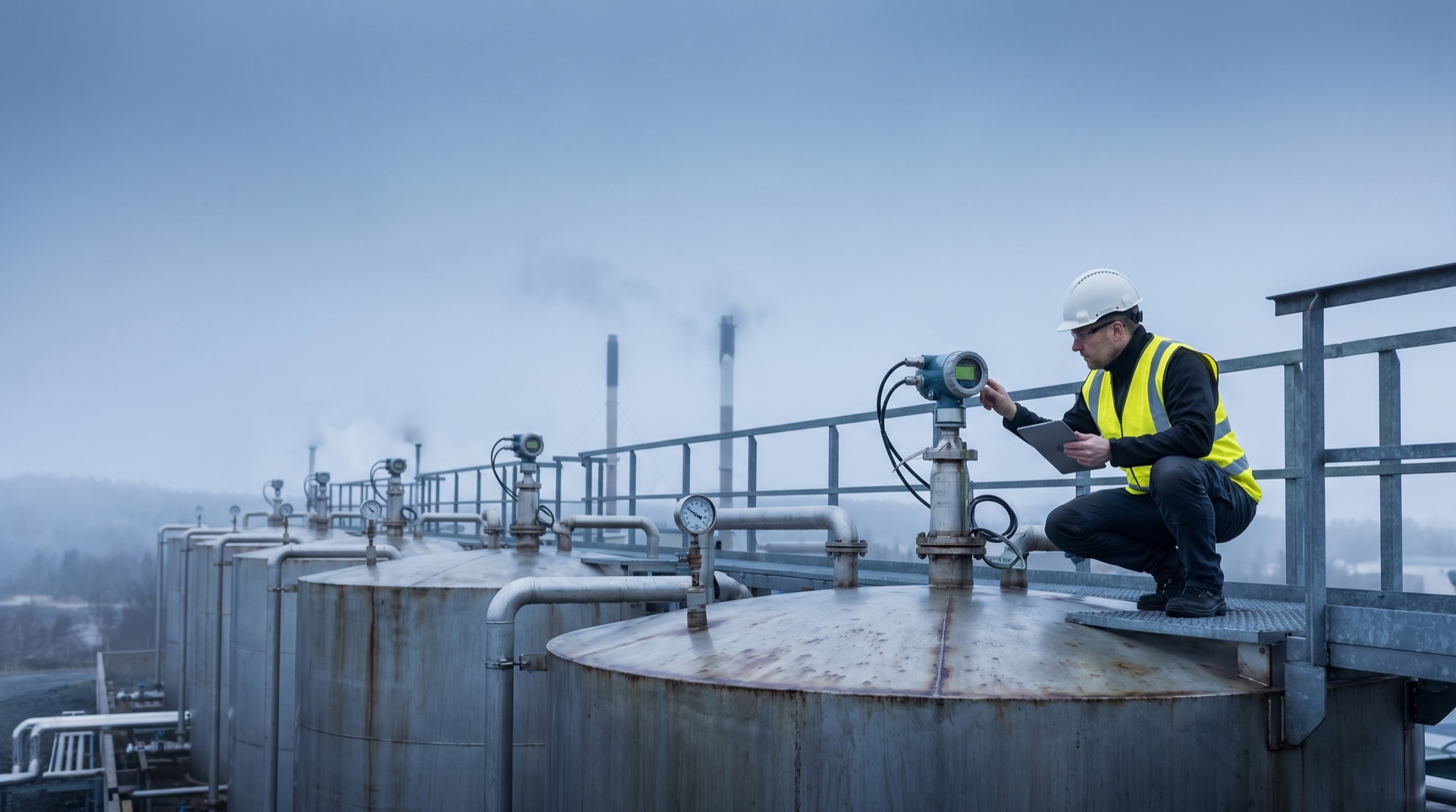
Vapour is the quiet enemy of acoustic measurement. In a heated tank or a chemical vessel with solvent vapours, the speed of sound in the head space no longer matches the value the ultrasonic transmitter assumes, and the level reading drifts with the process. Condensation on the transducer face damps the acoustic pulse further. A radar level transmitter is essentially indifferent to all of this, which is why radar is the default choice above acids, caustics and heated liquors.
Foam complicates both technologies. A heavy, wet foam blanket, common in digesters, aeration basins and surfactant-laden chemical processes, absorbs acoustic energy almost completely and attenuates microwave echoes as well. A light, dry foam may let radar see through to the true liquid surface. Where persistent foam defeats both non-contact options, a contact technology is often the practical answer; see our companion comparison of RF admittance and guided wave radar for extreme conditions. Foaming and vapour-laden head spaces are everyday realities in pulp and paper stock and liquor service as well, where the same selection logic applies.
For corrosive products, non-contact measurement is inherently attractive because only the antenna or transducer face is exposed to the vapour space. With chemically inert wetted materials selected to suit the process, both technologies can serve above aggressive chemistries without the maintenance burden of a wetted probe.
Sludge Blanket Detection and Wastewater Duty
Water and wastewater plants remain the heartland of ultrasonic technology, in duties that extend well beyond surface level. In primary and secondary clarifiers, the measurement that matters is often the sludge blanket, the interface between clarified liquor and settled solids. Sludge blanket detection uses a submerged, sonar-style transducer that sends an acoustic pulse down through the liquid and times the echo from the blanket interface, allowing operators to optimize desludge pumping, protect effluent quality and avoid sending thin sludge to digestion. The Pulsar measurement range carried by CTH covers this duty alongside conventional wet well, reservoir and open-channel level applications.
In pump stations, an ultrasonic or radar transmitter typically provides continuous level for pump control, backed up by independent switches for high-level alarm and dry-run protection; our guide to point level detection for alarms and pump protection covers that layered approach. Across the industries CTH serves, pairing continuous non-contact measurement with discrete point protection is one of the most common and most dependable architectures.
Which Technology Should You Specify?
As a practical starting point:
- Choose an ultrasonic level sensor for water, wastewater and ambient-temperature liquids in open or simple closed tanks, where the head space is air, foam is light or absent, and budget matters: wet wells, reservoirs, chemical day tanks and open channels.
- Choose a radar level transmitter where vapour, temperature swings, vacuum or pressure, foam tendency, tall narrow geometry or outdoor solar heating would undermine an acoustic reading: chemical storage, scrubbers, heated process vessels and corrosive service.
- Look beyond non-contact when buildup, heavy agitation or extreme vessel conditions defeat both. Technologies covered elsewhere in this series, from guided wave radar to nuclear level measurement systems for extreme process vessels, exist precisely for those cases.
Frequently Asked Questions
Is a radar level transmitter better than an ultrasonic level sensor?
Neither is universally better. Radar is more robust against vapour, temperature, pressure and foam, while ultrasonic is simpler and typically less expensive in clean, ambient applications. Match the technology to the head-space conditions in your vessel rather than to a general preference.
Can an ultrasonic level sensor measure through foam?
Generally no. Foam absorbs acoustic energy, weakening or eliminating the return echo. A thin, transient foam layer may be tolerated, but persistent thick foam usually calls for radar, and severe foam may require a contact technology such as guided wave radar.
Does vapour affect non-contact radar level measurement?
Far less than it affects ultrasonic devices. Microwaves travel at the speed of light regardless of gas composition or temperature, so ordinary vapours have minimal effect on the reading. Very dense, heavily condensing vapours can attenuate the signal, which an application review will identify before the instrument is specified.
What is the best non-contact level sensor for corrosive chemicals?
A radar level transmitter with chemically inert antenna materials is usually preferred, because corrosive tanks often carry vapours that disturb acoustic measurement. An ultrasonic sensor with a corrosion-resistant transducer face remains a sound, economical option where the vapour space is mild and at ambient temperature.
How is a sludge blanket measured in a clarifier?
With a sonar-style transducer submerged below the water surface. The instrument sends an acoustic pulse through the liquid and times the echo returned from the sludge interface, giving operators a continuous blanket level for desludge pump control and effluent protection.
Radar and ultrasonic instruments cover a remarkable share of level applications, but they are two entries in a much larger toolkit. For the full picture, including contact technologies, interface measurement and technology selection tables, return to our complete industrial level measurement technologies guide.
Request an Application Engineering Consultation
The fastest route to a dependable level loop is to put your vessel drawings, process conditions and control objectives in front of an application engineer before a model number is chosen. CTH Industrial Controls supports water, wastewater and chemical operations across Quebec and Canada with instrumentation from leading manufacturers, including the Foxboro and Pulsar lines discussed here. Request an application engineering consultation and we will help you select, configure and commission the right non-contact level measurement solution for your vessel.