




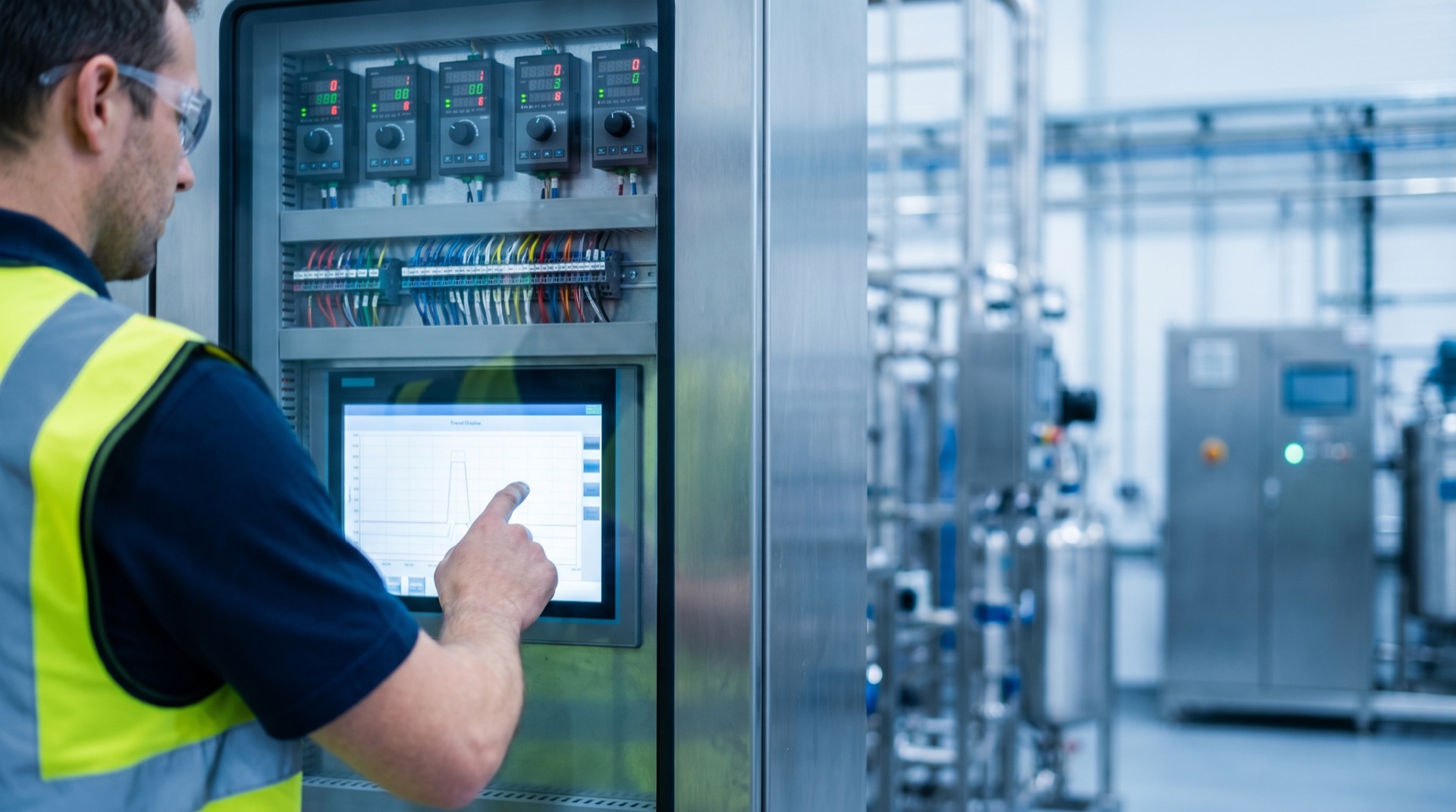
When a quality auditor asks for proof that a furnace held its soak temperature or that a pasteurization cycle ran exactly to specification, verbal assurance counts for nothing. The record is everything. A modern process controller paired with secure digital recording answers that question definitively: the controller holds the process within tight tolerances, and the recorder captures tamper-resistant evidence that it did. Together they form the documentation backbone of regulated operations, from aerospace heat-treatment furnaces to food and beverage cook lines across Quebec and the rest of Canada.
This article is part of our complete guide to predictive maintenance and process automation. Below, we look at how digital PID controllers and paperless recorders help plants meet compliance expectations such as ISO 17025 calibration practices and AMS2750E heat-treatment recording, and how that same data can feed a broader reliability strategy.
Why Compliance Drives Process Controller and Recorder Selection
Quality frameworks in aerospace, food processing and general industry share a common thread: they expect instruments to be accurate, calibrated against traceable references, and backed by records that cannot be quietly altered after the fact. That places the process controller and the data recorder at the centre of nearly every audit conversation. In practical terms, auditors tend to probe four areas:
- Measurement accuracy and repeatability: Can the control loop demonstrably hold the process variable within the tolerance the specification demands?
- Calibration traceability: Are controllers, sensors and recorders calibrated on a documented schedule, using references traceable to recognized standards?
- Record integrity: Is the recorded data protected against loss, gaps and undetected modification?
- Retention and retrieval: Can you produce the record for a specific batch, lot or furnace run quickly, even years later?
Choosing hardware with these expectations in mind from the outset is far less costly than retrofitting documentation capability after a failed audit or a customer quality escape.
PID Temperature Controllers: Precision at the Loop Level
A PID temperature controller continuously compares the measured process value against the setpoint and adjusts its output using proportional, integral and derivative action to minimize overshoot, droop and oscillation. Modern digital units go well beyond basic loop control, adding autotuning, multi-segment setpoint programming for ramp-and-soak thermal profiles, and configurable alarm and event outputs that document process deviations as they occur.
For compliance-driven applications, the selection criteria extend past control performance. Our range of PID temperature controllers includes instruments suited to demanding documentation environments, and Eurotherm controllers and recorders in particular are a familiar sight in heat-treatment shops and regulated processing plants worldwide. Jumo controllers, recorders and sensors round out the offering with additional options for temperature, process and recording duties. Features worth shortlisting include:
- Setpoint programming with segment event outputs for complex thermal cycles
- Digital communications (serial or Ethernet-based protocols) for integration with recorders, PLCs and SCADA
- Documented calibration adjustment procedures and restricted configuration access
- Independent alarm relays for over-temperature protection on critical equipment
Industrial Data Recording: From Circular Charts to the Paperless Recorder
Traditional pen-and-paper chart recorders served industry faithfully for decades, and many remain in service today. But paper has real limitations under modern audit scrutiny: pens dry out, charts are misfiled, resolution is limited, and retrieving a specific event from an archive room can take hours. A paperless recorder, sometimes called a videographic or graphic recorder, stores process data electronically in secure, tamper-evident file formats, with on-screen trend review, batch records and digital archiving to network storage.
CTH supplies the full spectrum of recorders and data acquisition systems, from conventional chart recorders for plants standardized on paper records to multi-channel graphic recorders with touchscreen displays for high-density industrial data recording. The comparison below summarizes the trade-offs:
| Consideration | Traditional chart recorder | Paperless / graphic recorder |
|---|---|---|
| Record medium | Ink on circular or strip charts | Secure electronic files on internal and network storage |
| Data integrity | Vulnerable to pen failure, paper damage and gaps | Tamper-evident formats with audit trails of configuration changes |
| Review and retrieval | Manual search through physical archives | On-screen and software-based search by time, batch or alarm event |
| Batch reporting | Manual annotation and transcription | Electronic batch records tied to operator and lot identifiers |
| Consumables | Ongoing pens, charts and storage space | Minimal; periodic media and backup management |
| Audit preparation | Labour-intensive collation | Rapid export of the exact time window requested |
Meeting ISO 17025 and AMS2750E Expectations
ISO 17025 is the international standard addressing the competence of testing and calibration laboratories. Plants typically encounter it through their calibration practices: the laboratories that calibrate your controllers, sensors and recorders, whether external providers or an internal lab, are often assessed against it, and it underpins the traceability chain your auditors will want to see. Maintaining calibration certificates, defined intervals and documented procedures for every loop instrument is the practical day-to-day expression of that expectation.
AMS2750E is the pyrometry specification widely invoked in aerospace heat treatment. At a general level, it addresses the classification of furnaces and instrumentation, calibration requirements for sensors and control and recording instruments, and the recording of thermal processing data. For suppliers to aerospace primes, demonstrating that furnace controllers and recorders are managed within such a framework is a condition of doing business. Because these documents are revised over time and applied differently by different customers, always verify current requirements with the issuing authority, your registrar or your customer quality representative rather than relying on summaries.
The encouraging news is that modern controller and recorder platforms were designed with exactly these regimes in mind: high-accuracy inputs, calibration adjustment records, secure data formats and the channel counts needed to record load thermocouples alongside control sensors.
Applications Across Industries
Aerospace Heat Treatment
Vacuum furnaces, atmosphere furnaces and ovens running solution treatment, aging and stress-relief cycles depend on programmable controllers executing precise ramp-and-soak profiles while recorders capture every zone and load sensor. The record accompanies the part lot as objective evidence that the thermal cycle met specification.
Food and Beverage Processing
Pasteurization, cooking, chilling and clean-in-place cycles all carry critical temperature limits, and audit-ready batch records are increasingly expected by customers and food-safety auditors alike. Paperless recorders simplify producing the history of a specific production lot on demand. Learn more about how CTH supports the food and beverage industry with instrumentation suited to hygienic processing environments.
General Industrial Plants
Boilers, environmental test chambers, curing ovens, reactors and dryers in petrochemical and pulp and paper facilities all benefit from tighter control and defensible records, whether the driver is a regulator, an insurer or an internal quality system. Explore the full range of industries CTH serves across Quebec and Canada.
Recorded Data as a Predictive Maintenance Asset
Compliance may justify the purchase, but the same high-resolution process history is a reliability goldmine. A control output that creeps upward over months can reveal a fouling heat exchanger; lengthening furnace heat-up times point to degrading elements or insulation; widening oscillation in a previously stable loop suggests a sticking valve or failing sensor. Reviewed systematically, recorder archives become an early-warning system in their own right.
That makes industrial data recording a natural companion to the other condition-monitoring techniques covered in this series, such as vibration analysis for pump bearing protection and industrial weighing and load cell systems. And where assets are remote or cabling is impractical, wireless communication for heavy industrial sites can carry recorder and controller data back to central historians without trenching a single cable.
Frequently Asked Questions
What is the difference between a process controller and a PID temperature controller?
A process controller is the general term for an instrument that regulates a process variable such as temperature, pressure, flow or level. A PID temperature controller is a process controller specialized for thermal loops, using proportional-integral-derivative algorithms to hold temperature at setpoint. Many modern units handle multiple variable types, so the distinction is increasingly about configuration rather than hardware.
Why choose a paperless recorder over a traditional chart recorder?
A paperless recorder eliminates consumables, stores data in secure tamper-evident electronic formats, and lets you retrieve a specific batch or alarm event in seconds instead of searching paper archives. For audit-driven environments, the electronic audit trail and rapid export capability are usually the deciding factors, though chart recorders remain a valid choice where paper records are an established site standard.
How does industrial data recording support AMS2750E heat-treatment compliance?
AMS2750E places expectations on the instrumentation used to control and record thermal processes in aerospace heat treatment, including calibration and the capture of process records. Multi-channel recorders allow control and load sensors to be documented together for each furnace run. Because requirements depend on furnace class, instrumentation type and customer flow-downs, confirm specifics with your registrar or customer quality authority.
Can a paperless recorder integrate with existing PLC and SCADA systems?
Yes. Most modern graphic recorders offer digital communications over serial or Ethernet networks, allowing them to log values from PLCs and share data with SCADA and historian software while still serving as the secure, independent record an auditor expects. Our application engineers can help confirm protocol compatibility for your specific architecture.
How long should recorded process data be retained?
Retention periods vary by industry, customer contract and regulation, and there is no single universal answer. Aerospace and food applications commonly require records to be producible for years. The practical approach is to confirm the retention requirement with your quality system and customers, then size recorder storage and network archiving accordingly.
Request an Application Engineering Consultation
Specifying controllers and recorders for a compliance-driven application involves channel counts, input types, accuracy classes, communications and data-security features, and the right answer depends on your process and your auditors. CTH Industrial Controls supports plants across Quebec and Canada with brands such as Eurotherm and Jumo, backed by application engineering experience in regulated industries. Request an application engineering consultation to review your control and recording requirements, or browse the manufacturers CTH carries to see the breadth of instrumentation available.
For the bigger reliability picture, including how recorded process data fits alongside vibration, oil and wireless condition monitoring, return to our predictive maintenance and process automation guide.