





Every maintenance manager has lived through it: a critical pump that ran fine on Friday is seized solid on Monday, and the repair bill now covers a scored shaft, a scrapped impeller and days of lost production instead of a routine bearing change. Vibration analysis for pumps exists to prevent exactly that scenario. By measuring how a machine vibrates, and how that signature changes over time, bearing wear detection becomes a planned maintenance activity rather than an emergency. This article is part of our complete guide to predictive maintenance and process automation, and it focuses on the practical side of pump vibration monitoring: which sensors to use, how to mount them, when to choose walk-around routes versus continuous monitoring, and how to think about alarm levels.
Why Bearing Wear Is the Failure Mode Worth Catching
Rolling-element bearings are among the most common failure points on centrifugal pumps, and they rarely fail without warning. Misalignment, imbalance, lubrication starvation, contaminated grease and cavitation all leave their mark on the bearing long before the pump stops turning. The encouraging news for reliability teams is that bearing degradation is progressive: microscopic spalling on a raceway generates distinctive vibration signatures weeks or months before the damage becomes audible, visible or hot to the touch.
Reliability engineers describe this with the P-F curve: the interval between the point where a potential failure becomes detectable and the point of functional failure. On rotating equipment, vibration is typically the earliest practical indicator available, appearing well before temperature rise or audible noise. It also pairs naturally with lubricant condition data; our companion article on industrial weighing and load cell systems covers that second line of defence in detail.
How Vibration Analysis for Pumps Detects Bearing Wear Early
A degrading bearing moves through recognizable stages. In the earliest stage, defects generate energy only at very high frequencies, detectable with techniques such as enveloping or demodulation. As damage grows, characteristic bearing defect frequencies and their harmonics emerge in the spectrum. Later still, the fault becomes obvious in overall velocity readings, and in the final stage the spectrum collapses into broadband noise as the bearing approaches seizure. The earlier in this progression a fault is identified, the more options the maintenance planner has.
In practice, most pump programs rely on a combination of techniques:
- Overall level trending: tracking a single vibration value over time to flag developing change.
- Spectrum analysis: breaking the signal into frequencies to distinguish bearing defects from imbalance, misalignment or cavitation.
- Enveloping and high-frequency techniques: isolating the repetitive impacts of early-stage bearing damage.
- Time waveform review: confirming impacting behaviour and looseness that spectra can mask.
Industrial Accelerometers vs. Piezo Velocity Sensors
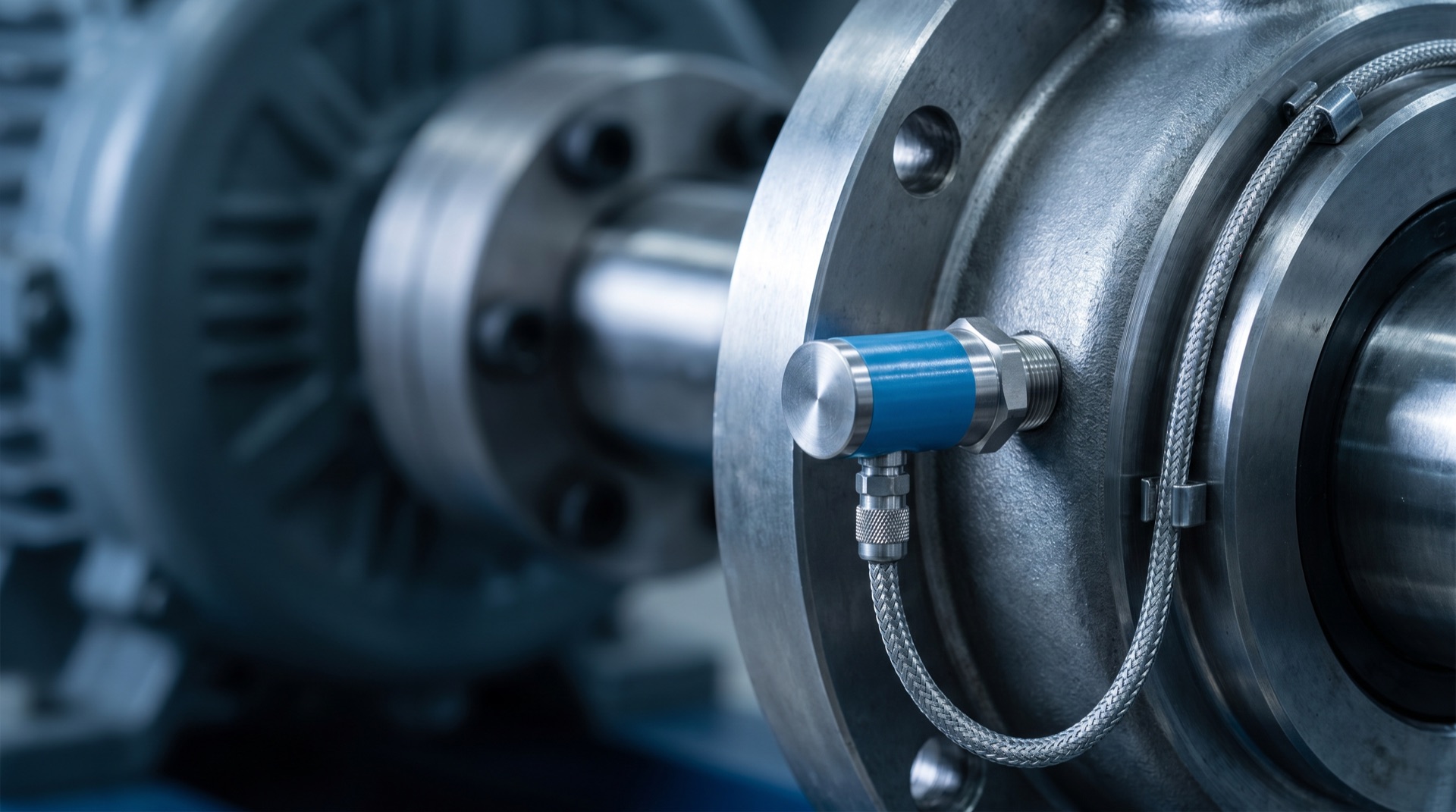
Two sensor families do most of the work in pump vibration monitoring. The industrial accelerometer measures acceleration and offers the wide frequency response needed to catch early-stage bearing defects. The piezo velocity sensor delivers an output proportional to velocity, which aligns directly with the way machinery severity is most often judged and trended. Many plants use both: accelerometers on bearing housings where early detection matters most, and velocity sensors where straightforward severity trending is the goal.
| Consideration | Industrial Accelerometer | Piezo Velocity Sensor |
|---|---|---|
| Measured quantity | Acceleration | Velocity |
| Frequency coverage | Wide, including the high frequencies of early bearing defects | Strong in the mid-frequency range where most machine faults appear |
| Best suited for | Early bearing wear detection, gear mesh, detailed spectrum analysis | Overall severity trending and protection-style monitoring |
| Typical application | Bearing housings on critical pumps and motors | General machine condition trending on balance-of-plant assets |
CTH Industrial Controls supplies CTC vibration sensors, a brand widely used across Canadian industry for condition monitoring. You can browse the full range of accelerometers and piezo velocity sensors on our site, and our team can help match sensor type, connector style and mounting approach to your specific pumps.
Sensor Mounting: Small Detail, Big Consequences
The best industrial accelerometer in the world cannot compensate for poor mounting. The mechanical connection between sensor and machine determines how faithfully high-frequency energy reaches the sensing element, which is precisely where early bearing wear lives.
- Stud mounting on a prepared flat surface gives the best high-frequency transmission and is the preferred choice for permanently installed sensors.
- Adhesive mounting pads offer a practical compromise where drilling and tapping the housing is not an option.
- Magnet mounts are convenient for walk-around routes, with the trade-off of reduced high-frequency response; consistent placement on the same spot each survey is essential for valid trending.
- Location matters: measure as close to the bearing as possible, in the load zone, and follow a consistent convention for horizontal, vertical and axial readings.
- Surface preparation counts: paint layers, rust and grease between the sensor and the housing all attenuate the signal.

Walk-Around Routes vs. Continuous Vibration Monitoring
Once sensors and mounting are settled, the next decision is how data gets collected. Route-based programs use a portable analyzer carried from machine to machine on a fixed schedule, while continuous vibration monitoring uses permanently installed sensors wired or wirelessly connected to a monitoring system.
| Factor | Walk-Around Routes | Continuous Monitoring |
|---|---|---|
| Data frequency | Periodic, typically weekly to monthly | Constant, catching transient and fast-developing faults |
| Cost profile | Lower hardware investment, higher recurring labour | Higher initial installation, lower ongoing labour |
| Best suited assets | Balance-of-plant pumps with gradual failure modes | Critical, unspared or hard-to-access pumps |
| Limitations | Faults can develop between surveys; access and safety constraints | Requires infrastructure for power, cabling or wireless links |
A criticality ranking usually settles the question: continuous monitoring for the pumps whose failure stops production or threatens compliance, routes for everything else. Continuous systems also need somewhere to send their data; many sites pair vibration channels with the platforms described in our article on advanced process controllers and data recording. For remote pumping stations and sprawling mine sites where trenching cable is impractical, see our overview of wireless communication in heavy industry.
Setting Vibration Alarm Levels: A Practical Starting Point
Alarm setting is where many programs stall, and the honest answer is that no universal threshold fits every pump. A sound general approach starts with a baseline captured when the machine is known to be in good condition, then sets an alert level at a modest multiple of that baseline and a danger level above it. Industry severity guidelines such as the ISO 20816 family provide general zone boundaries by machine class and can serve as a sanity check, but always verify the current edition and its applicability to your equipment directly with the standards authority. Just as important as any absolute value is the rate of change: a reading that doubles in a month deserves attention even if it remains below a published guideline. Review alarms after maintenance events, and treat them as living settings rather than set-and-forget numbers.
Where Pump Vibration Monitoring Delivers the Fastest Payback
The economics of vibration monitoring are most compelling where pumps are critical, remote or punishing to maintain. In mining, slurry and dewatering pumps operate under heavy loads in abrasive service, and an unplanned failure can idle an entire circuit; our overview of mining instrumentation and monitoring in Canada explores the broader instrumentation picture. Municipal water and wastewater utilities depend on lift stations and treatment pumps that often run unattended, where early bearing wear detection prevents overflows and emergency callouts. General industrial users, from pulp and paper stock pumps to petrochemical transfer services, apply the same principles across hundreds of rotating assets. Vibration data also complements process-side protection: pairing it with point level switches for dry-run pump protection guards against both mechanical and process-driven failures. Explore the industries CTH serves to see how condition monitoring fits your sector.
Vibration analysis is one pillar of a broader reliability strategy that also spans lubricant condition, process data recording and plant-wide communications. For the full framework, return to our predictive maintenance and process automation guide, which ties vibration monitoring together with the other condition-based maintenance technologies covered in this series.
Frequently Asked Questions
What is the best vibration sensor for pump bearing monitoring?
For most pump bearing applications, a general-purpose industrial accelerometer mounted on the bearing housing is the default choice because its wide frequency response captures early-stage defects. Piezo velocity sensors are a strong option where the goal is straightforward severity trending. Sensor selection should account for temperature, hazardous area requirements and cabling, which is where an application review helps.
How early can vibration analysis detect bearing wear?
With good mounting and high-frequency techniques such as enveloping, bearing defects are often detectable weeks to months before functional failure, depending on load, speed and operating conditions. That lead time is what allows parts to be ordered and repairs scheduled during planned outages instead of emergencies.
Should I choose route-based or continuous vibration monitoring?
Rank your pumps by criticality. Unspared, production-critical or hard-to-access machines justify permanently installed sensors and continuous vibration monitoring, while balance-of-plant pumps with gradual failure modes are usually well served by monthly walk-around routes. Many Canadian plants run both approaches side by side.
What vibration level is acceptable for a centrifugal pump?
There is no single number that applies to every pump. Acceptable levels depend on machine size, speed, foundation and service. General severity guidelines such as the ISO 20816 family offer zone-based reference points by machine class, but the most reliable yardstick is each pump’s own healthy baseline and its trend over time. Verify any standard’s current requirements with the issuing authority.
Can vibration analysis detect problems other than bearing wear?
Yes. The same sensors and spectra that reveal bearing defects also identify imbalance, shaft misalignment, mechanical looseness, impeller damage and cavitation, each with its own frequency signature. That breadth is why vibration analysis is usually the first condition-monitoring technology a plant deploys on rotating equipment.
Request an Application Engineering Consultation
Choosing the right sensor, mounting method and monitoring strategy for your pumps is easier with an experienced partner. CTH Industrial Controls supports mining, municipal and industrial customers across Quebec and Canada with vibration sensors from CTC and the broader lineup of manufacturers CTH carries. Request an application engineering consultation and tell us about your pumps; our team will help you build a bearing wear detection program that pays for itself.