





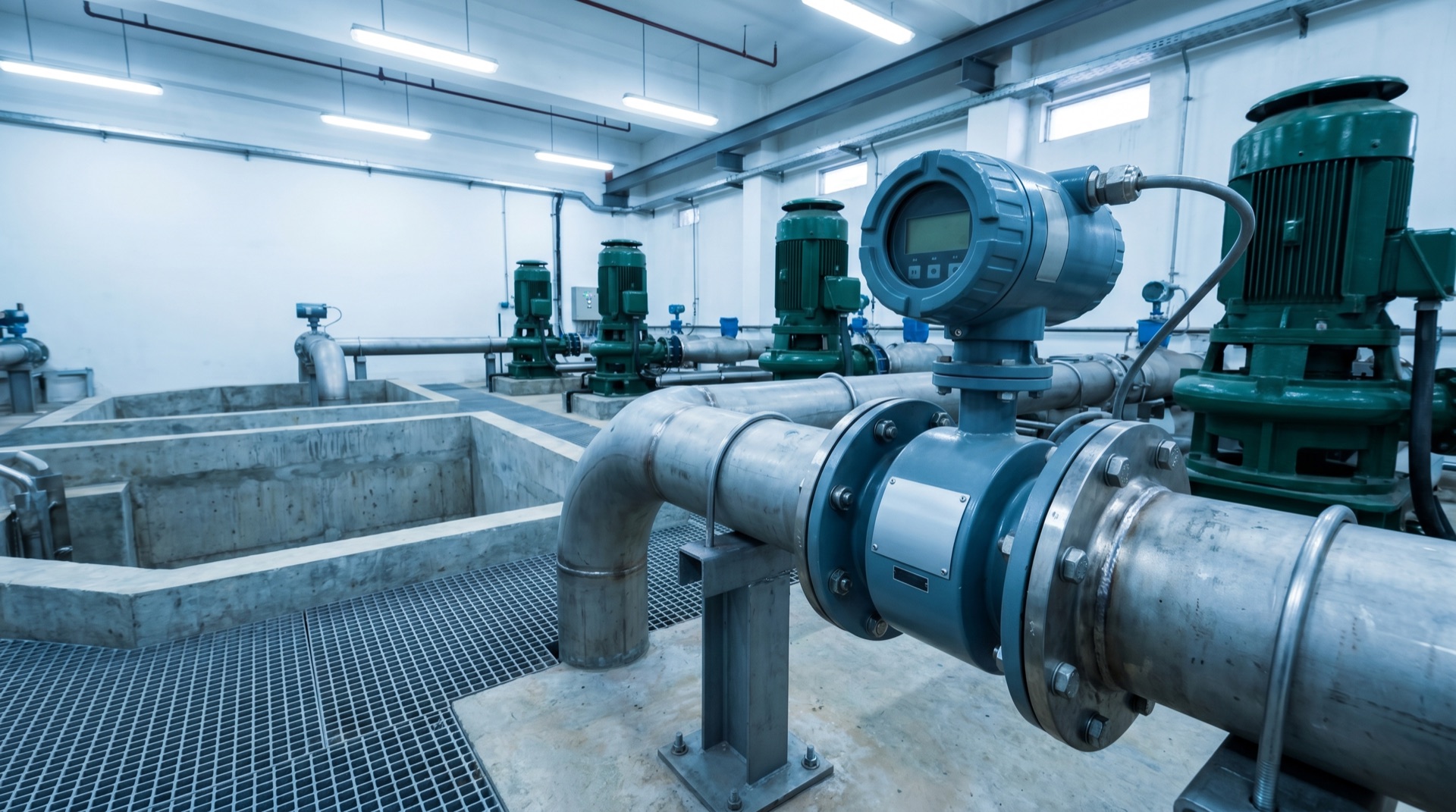
Few instrumentation decisions affect a treatment plant’s daily operation as much as flow meter selection. This magnetic flow meter wastewater selection guide explains how to specify electromagnetic flow meters for raw sewage, sludge, slurries and municipal effluent: which liner and electrode materials survive abrasive, coating-prone fluids, how to size the meter for solids-laden flow, and why grounding makes or breaks measurement stability. It is part of our complete guide to industrial flow measurement and custody transfer, which compares every major flow technology used in Canadian process plants.
Whether you operate a municipal treatment facility in Quebec, a pulp mill moving stock and white water, or a minerals operation pumping tailings, the principles below will help you specify an electromagnetic flow meter that performs reliably for years rather than months.
How an Electromagnetic Flow Meter Works
An electromagnetic flow meter applies Faraday’s law of electromagnetic induction. Coils mounted on the meter body generate a magnetic field across the pipe bore, and as a conductive liquid passes through that field it induces a small voltage proportional to its average velocity. Electrodes mounted flush with the liner pick up this signal, and the transmitter converts it to volumetric flow.
The practical implications for wastewater and slurry service are significant:
- An unobstructed bore with no moving parts. The bore is completely open, so rags, grit, fibres and solids pass freely with negligible pressure loss and nothing to wear out mechanically.
- Solids tolerance. Because the meter responds to the average velocity of the conductive fluid, entrained solids in sludges and slurries generally do not defeat the measurement the way they can with many ultrasonic or differential-pressure devices.
- Bidirectional capability. Useful for surge lines, filter backwash cycles and reversible pumping stations.
- Conductivity requirement. The fluid must be electrically conductive. Municipal water, wastewater, sludge and most aqueous slurries qualify easily; hydrocarbons, solvents and ultrapure water do not.
Magnetic Flow Meter Wastewater Applications: Where the Technology Excels
Across municipal and industrial plants, magnetic flowmeters are the default choice wherever the fluid is conductive and dirty. Typical applications include:
- Municipal wastewater: raw sewage and primary influent, return and waste activated sludge (RAS and WAS), digested sludge, polymer and coagulant dosing, and final effluent monitoring.
- Drinking water: raw water intake, distribution metering, filter backwash and inter-municipal transfer measurement.
- Pulp and paper: pulp stock, white water, liquor lines, bleaching chemicals and mill effluent, all core measurements for any pulp and paper operation.
- Mining and minerals: tailings, thickener underflow and other abrasive slurries.
- Food and beverage: sanitary versions handle conductive products and clean-in-place fluids in food and beverage plants.
Liner Selection: Matching the Material to the Fluid
The liner electrically isolates the measuring tube from the fluid and takes the full brunt of abrasion, chemical attack and temperature. It is also the component most often mis-specified. The table below summarizes common liner families for wastewater and slurry duty.
| Liner material | Typical wastewater and slurry service | Selection notes |
|---|---|---|
| Hard rubber (ebonite) | Raw sewage, sludge, general municipal water and wastewater | Economical workhorse for non-aggressive, mildly abrasive fluids at moderate temperatures. |
| Soft rubber / neoprene | Abrasive slurries with coarser particles | Elasticity absorbs particle impact and resists gouging. |
| Polyurethane | Highly abrasive slurries such as tailings, grit and sand-laden flows | Outstanding abrasion resistance; more limited chemical and temperature tolerance. |
| PTFE | Aggressive chemicals, bleaching agents, hot or steam-cleaned lines | Excellent chemical and temperature resistance; less abrasion-resistant than elastomers. |
| PFA / ETFE | Combined chemical attack and moderate abrasion | Often specified with reinforcement where vacuum or demanding cleaning cycles are expected. |
A useful rule of thumb: abrasion favours elastomers such as rubber and polyurethane, while chemical attack and elevated temperature favour fluoropolymers such as PTFE and PFA. Always confirm the liner rating against your actual fluid, temperature and cleaning regime, including steam cleaning and vacuum conditions that can collapse an unsupported liner.
Electrode Materials and Coating Countermeasures
Electrodes must resist corrosion and abrasion while staying electrically clean. Stainless steel suits most municipal water and wastewater. Hastelloy extends resistance to chlorides and many treatment chemicals, while titanium, tantalum and platinum cover progressively more aggressive services such as bleaching chemicals in pulp mills.
Electrode coating is the more common field problem in wastewater service: grease, biological films and sludge can insulate the electrodes and degrade the signal. Countermeasures worth specifying up front include:
- Bullet-nose or self-cleaning electrode geometries that encourage scouring by the flow itself;
- Electrode cleaning provisions or removable electrodes on coating-prone sludge lines;
- Maintaining fluid velocity high enough to keep wetted surfaces scoured;
- Orienting the meter so the electrode axis is horizontal, keeping electrodes out of settled solids at the bottom of the pipe and out of air pockets at the top.

Sizing and Velocity: The Heart of Slurry Flow Measurement
Correct sizing matters more in slurry flow measurement than in almost any other flow application, because velocity drives both measurement quality and meter life:
- Keep solids suspended. If velocity is too low, solids settle, electrodes coat and readings drift. Slurry lines should generally run fast enough to keep particles moving as a homogeneous stream.
- Limit abrasive wear. If velocity is too high in an abrasive slurry, liner and electrode erosion accelerates. The goal is a velocity window, not a maximum.
- Consider downsizing. Selecting a meter one line size smaller than the adjacent pipe, with concentric reducers, is a common way to lift velocity into a healthy range on oversized lines.
- Respect straight-run requirements. Follow the manufacturer’s recommended upstream and downstream straight pipe lengths, and keep the meter away from pump discharges, partially open valves and injection points.
- Keep the pipe full. Standard magnetic flow meters require a full pipe. Installing the meter in a vertical line with upward flow, or in a low rising section, is the classic safeguard for sludge and slurry duty.
Grounding: The Most Overlooked Step
An electromagnetic flow meter resolves signals at very low voltage levels, so it needs a stable electrical reference to the process fluid. Poor grounding is the single most common cause of noisy or drifting readings in wastewater plants, where lined pipe, plastic pipe, cathodic protection systems and variable-frequency pump drives all complicate the electrical environment.
- On conductive, unlined metal pipe, bonding straps between the meter and adjacent flanges are often sufficient.
- On lined, coated or non-conductive pipe, grounding rings in contact with the fluid, or a meter equipped with grounding electrodes, restore the reference.
- Where cathodic protection or stray currents are present, follow the manufacturer’s dedicated grounding and isolation practices.
- Route signal cabling away from variable-frequency drive power runs and maintain shielding and earthing as specified.
Commissioning checks should always include verifying grounding continuity, a full pipe at zero flow and a stable zero reading before the meter is put into service.
Specifying Mag Meters for Municipal and Mill Service in Canada
Canadian municipalities rely on electromagnetic meters for influent and effluent measurement that feeds regulatory reporting, for inter-municipal water transfer metering and for process control across the plant. Where flow measurement supports billing or trade measurement, additional obligations may apply under Measurement Canada requirements; verify the applicable rules directly with the authority before finalizing your specification.
CTH Industrial Controls supports municipal utilities, pulp and paper mills and other industrial customers across Quebec and Canada with a full range of flow instrumentation, including Foxboro (Schneider Electric) electromagnetic flow meters, widely specified in municipal water, wastewater and pulp and paper service. Explore the full scope of industries we serve to see how flow measurement fits into broader instrumentation programs.
When Another Flow Technology Fits Better
Electromagnetic meters only measure conductive liquids, so some applications call for a different approach:
- For low-conductivity fluids, solvent service or mass-based dosing accuracy, see our guide to Coriolis mass flow measurement for chemical batching.
- For large clean-water pipelines or retrofit projects where cutting the pipe is impractical, see ultrasonic flow meters for pipelines and custody transfer.
- For steam, gases and plant air, see vortex and DP cone meters for steam and gas flow measurement.
Frequently Asked Questions
What minimum conductivity does a magnetic flow meter need in wastewater service?
Electromagnetic flow meters require a minimum fluid conductivity that varies by manufacturer and model, typically in the low microsiemens-per-centimetre range. Municipal wastewater, sludge and most aqueous slurries sit far above typical thresholds, while demineralized water, hydrocarbons and solvents fall below them. Always confirm the threshold on the datasheet of the specific meter you are considering.
Which liner is best for abrasive slurry flow measurement?
Polyurethane and soft rubber liners generally provide the best abrasion resistance for slurries such as tailings, grit and sand-laden flows. Where the slurry is also chemically aggressive or hot, a fluoropolymer such as PTFE or PFA may be the better compromise. Liner selection should always weigh fluid chemistry, temperature and particle characteristics together.
Can an electromagnetic flow meter handle raw sewage with rags and grit?
Yes. The open, obstruction-free bore is exactly why magnetic flow meters are among the most widely used technologies for raw sewage and sludge. For long service life, specify an abrasion-resistant liner, robust electrode materials and a velocity range that keeps solids moving without accelerating liner wear.
Why do magnetic flow meters in wastewater plants need grounding rings?
Much of the piping in treatment plants is lined, coated or plastic, which provides no electrical reference between the fluid and the meter. Grounding rings in contact with the process fluid, or built-in grounding electrodes, restore that reference. Without proper grounding, readings can become noisy, drift or shift with pump operation.
Can a magnetic flow meter be used for water billing between municipalities?
Magnetic flow meters are widely used for inter-municipal transfer metering and effluent measurement. Where the measurement supports billing or legal trade, additional requirements may apply; verify your obligations with Measurement Canada and any applicable provincial authority before finalizing the installation design.
Request an Application Engineering Consultation
The right liner, electrodes, sizing and grounding plan can be the difference between a meter that runs untouched for a decade and one that becomes a maintenance burden within a year. The application engineering team at CTH Industrial Controls helps municipal and industrial customers across Quebec and Canada specify electromagnetic flow meters for wastewater, sludge and slurry duty, drawing on the instrumentation manufacturers we represent, including Foxboro (Schneider Electric). Request an application engineering consultation to review your application, and for the broader technology comparison return to our complete industrial flow measurement and custody transfer guide.